Version 1.2 is up.
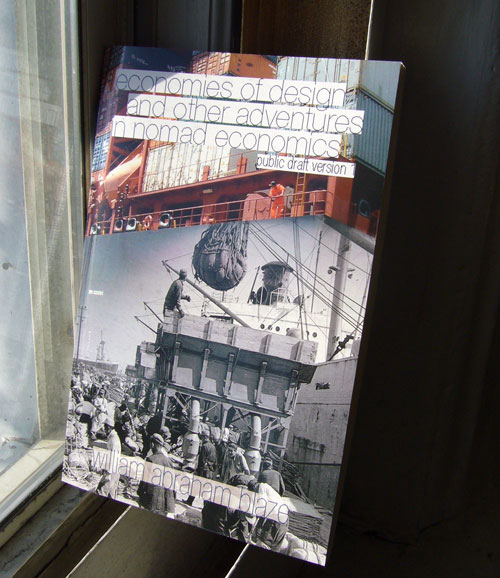
you can download it here as a pdf (for free!) or buy it here as a book.
]]>The Psychological Consequences of Money -- Vohs et al. 314 (5802): 1154 -- Science
Interesting work from psychology, complements Viviana Zelizer work in sociology in interesting ways, as well asll those game theory studies showing that economists as a profession are prone to make more selfish decisions than non-economists.
]]>Peter Agre: "Well, if I can milk a cow I suspect a monkey as smart as I am can milk a cow."
Stephen Colbert: "Are there monkeys as smart as you?"
Peter Agre: "I'm sure there are quite a few, quite a few.
Stephen Colbert: "Oh really? Mmhum. Do they give a Nobel prize for throwing your own feces?"
Peter Agre: "........That's the Economics prize, I think."
]]>FT.com / Home UK / UK - Lessons in economic reality(via MaxSpeak)
]]>A renegade economic object is whole new approach to economics, although if you read some of the first round drafts it should come as no surprise that it has roots in the institutional economics of Thorstein Veblen. Renegade economic objects split the difference between the dominant liberal/neoclassical economics and the various socialist/marxist/conservative approaches that constitute the alternative. Neoclassical economics is ultimately a reductionist approach that sees economies entirely in terms of the actions of individuals, and then transformed into a mass form via the "invisible hand" of the market. Most alternatives counter this view by looking to very large entities, in particular governments and "society" for their answers.
Renegade economics objects are a class of entities that lies between these two poles. They are larger than individuals, yet smaller than governments (or at least the larger ones) and far more concrete than "society". Corporations are renegade economic objects. So are social networks. Markets themselves (but not "the market") are renegade economic objects. So is money itself. Non profit corporations are renegade economic objects too, as are open source software projects. Terrorists groups are often renegade economic objects, and perhaps the "military industrial complex" is too. Closer to home families are renegade economic objects and cities, neighborhoods and other urban concentrations are too. There is a whole world of these things, and it has just begun to be explored.
To be a renegade economic object three qualifications must be met. One it must involve the interactions of multiple individuals. Two it must possess emergent properties, if it's function can just as adequately and usefully be described via some smaller objects than there is no reason to use the larger object. Finally it must be real; overly large and amorphous constructions like "society" or "capitalism" are not objects at all, and ultimately do not even exist except as concepts. Renegade economic objects are very real and that is exactly what makes them so powerful, they are means by which we can attempt to improve the economy around us.
]]>Now the only thing that is actually new with this version is the version number, which is now 0.3. The content is otherwise identical to version 1.2. It's just that as a public draft I think it really shouldn't be numbered 1.anything and so at risk of some confusion I have changed the sequence. I guess that makes the 1. versions collector's editions or something...
]]>Version 1.2 is up.
you can download it here as a pdf (for free!) or buy it here as a book.
]]>Actually it wasn't as bad as I was dreading cause I decided in this day and age of Amazon and Google that including the city and publisher is now unnecessary. My copy of MacKenzie's excellent An Engine Not a Camera came this week too and I noticed it doesn't have any cities listed either so maybe its the start of a trend. I'm guessing the cities were once part of the bibliography because you would need to call up an operator in that town in order to track down the publisher, clearly not the most necessary info in a google dominated world. Leaving out the publisher is probably a bit more controversial though. For one there is a small chance, particularly for big public domain books, that multiple publishers have released something in the same year. Beyond that though I suspect book publishers don't want to see themselves seen as unnecessary when making their biblography guidelines...
]]>Next up I get this site tight and start updating the book...
Network. What is a network? Other than the hot terminology of the moment of course. It is a word that gets tossed around a lot, and rarely well understood. I am certainly guilty of tossing it around a lot in these texts, so with some luck at least I try to help you understand it the way I understand it. Or understand them. A network, what is it? what are they?
First lets go the boring and safe route and see what the Oxford English Dictionary has to say. It has 13 different definitions just for the use of the word as a noun, and of those 13 a full nine of them are actually relevant to our use
-A piece of work having the form or construction of a net; an arrangement or structure with intersecting lines and interstices resembling those of a net.
- A chain or system of interconnected immaterial things.
- Any netlike or complex system or collection of interrelated things, as topographical features, lines of transportation, or telecommunications routes (esp. telephone lines).
- Broadcasting. A broadcasting system consisting of a series of transmitters able to be linked together to carry the same programme; a group of radio or television stations linked by such a system; (chiefly U.S.) a large (esp. nationwide) broadcasting company which produces programmes to be relayed to affiliated local stations. Also (occas.): a nationwide broadcasting channel.
- Computing. A system of interconnected computers. Freq. attrib. local area network, wide area network: see the first element.
- An interconnected group or chain of retailers, businesses, or other organizations.
- An interconnected group of people; an organization; spec. a group of people having certain connections (freq. as a result of attending a particular school or university) which may be exploited to gain preferment, information, etc., esp. for professional advantage.
- Math. A graph, esp. a digraph, in which each edge has associated with it a non-negative number (its capacity).
- Math. A diagrammatic representation of interconnected events, processes, etc., used in the planning of complex projects or sequences of operations.
Ok, maybe you can get a sense of why network is such a tricky term to pin down. It can mean just about anything: "A chain or system of interconnected immaterial things", "Any netlike or complex system or collection of interrelated things", "A diagrammatic representation of interconnected events, processes". But a few key features do stand out in that long list of definitions. "Inter" is key, purality is key, a network is never about one thing but about multiple things that are connected. Lets make it really simple, a network is connected things. Lines and nodes. Things and the things that connect the things.
Still pretty much anything can be a network. No that is wrong pretty much anythings can be a network. One thing can never be a network unless that thing can be broken apart. And if anythings can be a network how is a network useful to us?
Well it's useful because so many things are networks, or at least hold the potential to be networks. It's useful not because of the things though, the world is full of useful tools for addressing and understanding things. It's useful because of the inter, the lines, the connections between the things. The world is not full of useful tools for addressing and understanding what connects things together, and a network is important because it marks a start.
If you look back over that list of OED definitions perhaps you will understand just why we can not just throw the term network around casually (although of course we do anyway). A computer network is not the same as a broadcast network, the internet is not NBC, a LAN is not the BBC. Nor is a "system of interconnected immaterial things" the same as a "diagrammatic representation of interconnected events". But that is where it starts to get more complex, for the math always has the potential to also offer an explanation or way towards greater insight into any other network. Yet having potential is not the same as a guarantee. If anything could hold this collection of definitions together, if anything could make these things a network, it is the math. But that is a wildly unproven proposition, we must be wary of thinking that one network might behave like the next just because of the math (although of course we do anyway).
Perhaps the most fundamental question we can ask ourselves about a network is, is it real? Some networks are, others are closer to imaginary, and distinguishing the two is often difficult, sometimes impossible and sometimes a very distinct possibility. A network can be said to be real if we can accurately identify the mechanisms by which all nodes connect to each other. We can call these networks protocological networks or generative networks because it is through protocols embedded in the nodes that the network is generated. Computer networks are the classic example of this, although the postal system or the hub and spokes system of a late 20th century airline are close to as valid examples. Computer networks are idea still though, because the protocols can usually be run entirely by machines and thus enforced with a degree of rigor that mere humans can not always maintain. A renegade postman for instance can opt to trash a load of mail and spend the day at the ballpark, while a digital router is far more likely to stick to the protocol in doing its job.
Most networks are not protocological at all, or at least have yet to be confirmed to be protocological but instead are what could be called traced networks. These networks can not be said to be real, although they certainly can be suspected of being so. In a traced network there is no proof that the connections are actually relevant other than the word of the observer. In other words what ties all the elements together is not necessarily inherent in the elements themselves, but instead has been applied externally. This does not mean that the network in question is not actually cohesive, just that we can not prove that it is. Yet a network by definition transforms a multitude of things into one, a bunch of nodes become one singular network. If that cohesion can not be explained through protocol, through the nodes themselves, than it must be assumed to have been vested there by the identifier.
If one is identifying a traced network, perhaps you can say they are capturing a network, then it is critical that the suspected source of cohesion be identified. There are at least two very valid reasons for vesting a collection of things with the unifying identifier of a network. One is the belief that there actually is a protocol, but that it just has not been discovered yet. Another is that there is no actual cohesion to the network, the network is not real at all but instead an artificial construct used explicitly to collapse a complex set of objects and connections into one neat construct. While this can be an incredibly useful intellectual tool, it is absolutely essential to remember that such a network has no agency of any sort. The artificial network itself can not be used to explain anything, but rather any explanitory powers it possesses must come from somewhere, some mechanism, within the network.
The original networks were quite literally large workings of nets, and their home territory was the fishing villages and trading ports along the ocean. That the first real global networks to develop where in large part also tied to the sea via these ports is most likely a coincidence, although one wonders if the merchants saw echoes of their crisscrossed routes and exchanges in the netting holding down their cargoes. If their home was the sea then the home of the major protocological networks must have been the air, although early communications technology, from complex messenger systems to the telegraph wires where rooted to the ground. But the technology driven worlds of radio and television really forced protocols up into the atmosphere and with satellites beyond. The computer networks of course started on the ground too, but over the past few years are reaching for that wireless space as well, it is perhaps no accident that Apple brands its wireless technolgy "airport".
The traced network really found it's first home in sociology, a discipline, less concerned with the earth, sea and air and more perhaps with the ether. On might suspect their interest in networks originated as an attempt to figure out the mysterious workings of that mythical construct of theirs "society". That might sound like a critique, but it is not for some of the journey's they have produced have been truly fantastic, Howard Becker's immensely enjoyable Art Worlds springs to mind first. Perhaps more importantly boldness of sociologists in jumping into the concept of a network has produced a wealth of insights and techniques from which to build on.
The finest articulation of the traced network concept is Bruno Latour's (as a clear leader of a loose group) Actor Network Theory or ANT. Latour is by no means an uncontroversial figure among sociologists to the point where it might just be best to not look at him as a sociologist at all, an idea he seems to flirt with then discard in his latest and most accessible work Reassembling the Social. Indeed it is the terms that he brings in and then opts to discard that are most potent and telling in that book. Sociology Latour argues should no longer be about "society", a concept, I might add, that is so broad and amorphous that it is better suited for explaining away then for actually explaining. Instead he proposes that sociology should be about associations, before as an aside wishing that he could use the rather glorious term "associology". Instead he concludes "alas, the historical name is 'actor-network-theory', a name that is so awkward, so confusing, so meaningless that it deserves to be kept." With a bit of research into the context though one see that he really means something more along the lines of "I've tried to kill this dumb fucking name for two decades now, and it won't go a way so I better just embrace it again".
As one might gather from the name that historical Actor Network Theory name, associology is where the social sciences have really begun to grapple with the slippery concepts of networks. Not just any networks though but very explicitly just traced networks. I'll let Latour round off the details here: "Network is a concept, not a thing out there. It is a tool to help describe something, not what is being described. It has the same relationship with the topic at hand as a perspective grid to a traditional single point perspective painting: drawn first, the lines might allow one to project a three- dimensional object onto a flat piece of linen; but they are not what is to be painted, only what has allowed the painter to give the impression of depth before they are erased." (Latour 2005, p131)
To distinguish these traced networks from the real, or in Latour's terminology "technical networks", Latour proposed and then immediately discards the simultaneously awkward and elegant "worknet". Well perhaps it is more awkward than anything else, and in the end I doubt it will survive. Yet it does compress the sense that these networks identified by these sociologists and associologists and as networks become more trendy by other disciplines, and other less disciplined people (like me!), are not real at all, but in actuality the products of people doing work in order to cast a net around some set of things. In other words worknets/traced networks are apparatuses of capture. Ways to take the amorphous and hard to pin down collections and trap them into one thing, into one network.
Ultimately though this capture holds it's own trap, for if an actually mechanism of cohesion does not exist for the network, how does one know where the network ends? And how does one know if what is left out is just the necessary holes in the net or in fact whole collections of nodes? The question is really one of cohesion, the tracer is out to turn a collection of things into one network and as such must provide some element of cohesion to transform many into one. The simple answer is to just pick one thing and generate the entire network out of connections going into and out of the thing. In an early work Latour himself chose Louis Pasteur the great French scientist. But this approach is clearly problematic, in that each connection tends to lead towards more things, things that each have their own potential networks. At some point the lines must be drawn and the work turned in to a publisher, or else the associologist themselves might perish. And it is exactly at this point that Latour finds his point of cohesion. What ties this network together should not be tied to any given point in the network, but instead is the book itself!**
Now it is pretty easy to frame that concept as critique, to frame it as a cop out, the associologist (and sociologist too) is out there trying to trace a network and it goes on forever so he just bounds it nice and conveniently where the book ends. But in fact it should not be seen as a critique at all but instead an act of radical liberation. For the associologist in action is at high risk of trapping themselves into the network of their own devising. By seeing the book itself as the final point of cohesion suddenly the are free to stop pretending to be social scientists and instead become social novelists. And if one stop to realize that sociologists are interested in gaining a fuller understanding of the world and that for centuries this sort of understanding has always been best communicated not via academic publishing but via literature.
None of this means that associologists should just go out and make everything up. No, just as good novelists often do extraordinary amounts of research, the associologist also must head out to the field and discover. A good novel after must possess novelty, just as a good work of academic research must produce some new. This means in effect that the associologists actually possess a tremendous unfair advantage over traditional novelists. The associologist after all is connected to an extensive apparatus designed for the discovery of the novel, the poor novelist needs to go out and do all the work on their own. That massive advantage is quickly tossed out the window when one considers that becoming a sociologist requires an extraordinary indoctrination into some techniques of bad writing. Latour, for all his attempts to the contrary, has not done anything to change this situation, expect perhaps to accelerate it, and unfortunately I would probably be just as guilty were I actually to be a sociologist. Of course a little acceleration can go a long way too, perhaps sociology's problems might actually stem from being too adequate as writers. In fields where the writing is even worse, economics being the case to point although physics and biology probably fit as well, it often gets bad enough that someone actually tries to make it better.
While early economics was blessed with a series of writers capable of writing decent prose, it movement deeper and deeper into the obscurities of math was met by a remarkable series of translators, writers capable of transforming the dense concepts of the field into crisp public prose. The latest example the ingenious Freakonomics tag team of an economist with a professional journalist, represents something new though, an attempt by economics profession to hijack sociology's turf. The battlelines were laid a few decades ago, when Margaret Thatcher, channeling Friedrich Hayek declared "there is no such thing as society. There are individual men and women."* When the Freakonomics team, channeling Gary Becker, says "incentives matter" this is ultimately their point, for neoclassical economics wants nothing more than to explain away society as the actions of selfish or hedonistic individuals. Out of all the sociologists it is Latour who provides the strongest strike back against this move, perhaps channeling Thatcher his argument can be boiled down to: there is no such thing as society, only networks.*** But it is now left to the associologists, if any even exist, to tell that story.
*She actually also added "and there are families" to the end of that, she was of course a diplomat. It also can be seen as a foot in the door towards a whole world of other institutions, a critical point elsewhere in this work.
** There is a very clear and interesting parallel with Deleuze and Guattari's overused figure of the rhizome, which they actually explicitly (if not particularly clearly) introduce as being a book. Interestingly Latour, who is familiar with their work does not seem to catch or acknowledge this, although he does occasionally give nods towards the rhizome terminology.
*** Latour does not say it quite that implicitly, one wonders if paraphrasing Thatcher would be too much even for his rather developed taste for the intellectual shock. His actual words are a bit more like this: "Conversely, when our definition of the social is retraced, the common definition of the social has to vanish first. It's hard to see a more extreme contrast: it is either a society or a network." (2005 p.131)
]]>Often the question is nested inside one about my graduate program, NYU's Interactive Telecommunications Program. What does it have to do with ITP? There are a variety of ways I've tried to answer that. For one no one really knows what ITP is, its an ever evolving experiment in technology education, so it's often easy to just say "why not?" Or I can tell a personal story, I have a range of interests, design, tech theory, physical computing, and ITP is the space where more of them intersect than most. A nomad economics certainly isn't at the core of ITP, but it comes in on multiple peripheries, Art Kliener's study of management and organizations, Douglas Rushkoff's investigations into the pragmatics of consumer choice, Clay Shirky's "network economics", Steven Johnson's emergence, Alex Galloway's protocols... The one answer that almost got me to a real one was originally a throwaway phrase, "economics is the original mediated interaction".
It took a while to make that something clear and cohesive though. It came at one of those moments, I suspect I'm not alone in having them, where you've been studying something for a while, in depth, perhaps in too, and all of a sudden you pull back and say "what is this stuff anyway?"
So what is economics anyway? It's one of those questions that rarely gets bothered to be answered. We all have some sense of it, but economics text books tend to rush past in a page and practitioners are in way too deep to care about such a simple thing. But in a moment of vertigo, I found myself pulling back and needing to answer it.
economics: noun a social science concerned chiefly with description and analysis of the production, distribution, and consumption of goods and services. (Merriam-Webster Online)
The dictionary definition wasn't bad and this one better than some, but it was also unsatisfying, all of them. Some unpacking was in order. A social science means it's concerned with humans, but it's rather telling that most definitions tend to obscure that fact. First and foremost economics is about humans. It's about humans and the "production, distribution, and consumption of goods and services". Now goods and services can roughly be broken down to two more elementary particles, materials and information. And "production, distribution and consumption" can similarly be reduced down to movement and transformation.
Economics then can be defined as the study of the relationship of humans to the movement and transformation of materials and information.
Pause.
Let that one sit for a second, definitions are important.
Humans, materials, information, the moment I had that definition everything made a little bit more sense, the definition of economics was startlingly familiar, and more than anything else it was nearly identical to how I would define the practice of design. The relationship of humans to materials and information this is exactly where any design practice begins. On a textual level at least design and economics are practically identical!
Of course this isn't true in reality, as disciplines design and economics are radically different, with only rather rare and limited points of explicit crossover. The two disciplines are standing at nearly the exact same intersection, yet they want nothing to do with each other. Quiet honestly they don't even see to realize they are standing at the same place. And more than anything this thought struck me as intensely familiar.
As an undergraduate I studied anthropology. Or at least I started studying anthropology, by the end, while I had learned a few important things, I was mainly just frustrated by it. What had intrigued me about it, made me excited, made me want to charge into the classroom and learn, was how it sat at the juncture of so many disciplines. Biology, language, history, culture, theory, psychology, and yes even occasionally economics and nearly everything else short of physics. What could be a more fascinating and rapturous place than the intersection of these intensely human things?
Except.... well, when I got to that place something was horribly wrong. Here they were, biological anthropologists, psychological anthropologists, linguists, cultural anthropologists, there offices all lining the same hallway next to each other, all standing in the same place. Yet somehow they all were facing away from each other, ignoring each others words, preaching different gospels. As a student I felt completely lost, I wanted nothing more than to sit down at a table and launch a conversation between them all, but it just wasn't happening. Today I would have gotten angry not frustrated, and then I'd set about trying to change things. But back then I just settled on graduating and setting off into the world, leaving anthropology behind, although not necessarily what you could call the "anthropologist's eye".
Today the intersection of anthropology and design is a hot little field, the two go hand in hand it seems sharing the same obsession with humans and their objects and their information. Back then though it was a whole new world for me to become a designer, and after a quick detour through the bond trading floors of Wall Street, I set to work teaching myself the trade. Looking back it's clear I was just tackling the exact same problem from another angle. Design takes a far more pragmatic approach, it starts from the objects and works back and forth with the human side of things, but always ending up with a something as the result. Some of these things are more tangible than others, a hammer or a cellphone, as opposed to the bits of a website, the ink on paper of a poster or the light on a screen of motion graphics. But it's always a thing in the end (although recent events are threatening to change that.) Anthropology has always been about people first, the things are tools to learn more about the people. Economics isn't super concerned with either, but instead tends to focus on the movement between the two, the transactions that occur when people and objects meet in motion.
Transactions is a careful chosen word because it's always been a curious trait of neoclassical economics that while it's always about the movement of goods, services and wealth, it always wants to talk about them statically, in equilibrium. A nomad economics is about the movement, the connections, the circulation between humans and objects, money and information. Call it flow, to use an already overused yet under-appreciated term.
It is also at this point where design is moving ever so slightly closer to economics. In a move rather parallel to the way the "big five" accounting firms moved into consulting, leading design firms, IDEO and frog namely, are pushing towards the consulting business as well. "Design thinking" is the buzzword, but how and why its happening is I think a legitimate story. Consulting is a practice I like to think of as "pragmatic economics". It's concerned with the actual economy, with how firms are run, with how business gets done. Not with models and theories of economy, but with actual practice. And management consulting has for a long time been tightly interrelated with another site of pragmatic economics, accounting. A one point the "big eight" (at the time) accounting firms did just one thing, they came in and they audited the books, they ran the numbers from an outsiders perspective and then left. But coming in from the outside and looking at the numbers gives the account a rather remarkable perspective on how a business gets done. Being able see all the numbers of competing firms sure didn't hurt either, and it was only a matter of time before a significant amount of the accounting firms business came from consulting.
For a long time a designer's job was to make things. And when those things had pages or screens with was to organize information. Make the object, shape the information, cash the check and go. But to properly design a thing, to really do it right requires an intense understanding of the context. How does it get made? Who is the audience? What do they expect? How does it get sold? By whom? Where? Questions that sound a whole lot like economics. The questions might be similar but the approach is radically different. Design in this sense is moving towards another state of consulting, another state of pragmatic economics.
A nomad economics is in many senses a pragmatic economics as well, but it can not be limited solely to it. Instead it needs to reach towards the abstract, towards theory, but in doing so it must remain pragmatic. A pragmatic theory of economics, or better yet pragmatic theories of economics. It is in this space, where business practice meets anthropological understanding, meets the motion and transformation of materials and information that a nomad economics emerges from, evolves from, becomes cohesive. Accounting, anthropology, design, management consulting, materials in motion, information in circulation, this is where we begin, a nomad economics.
]]>Lets start with a small experiment. Without looking how much cash are you carrying on you? Or if the answer is currently nothing, how about the last time you went out?
Now count the cash, get an exact figure, down to the pennies. Odds are it's not exactly the same as the first answer is it? Do the math, figure out the difference, this is a very rough indicator of what your own personal nomadic threshold might be. Maybe it's a few pennies, maybe its a few bucks, maybe its a million dollars, in a dream that is.
The nomadic threshold is a phase change, a point where the behavior of money changes, much the way the properties of water transform as it turns from liquid into ice. On one side of the threshold is money as a number, as something you calculate, or at least try too. On the other side is liberation, money that you don't even think about, money whose metric value is just something you might notice in passing as you hand it over. Money you forget is in your pocket, handbag, sock or where ever else you may keep it. Money that's not worth your time to think about, but may well be worth a candy bar or a beer.
For most people the nomadic threshold is far too low. In Williamsburg, Brooklyn there is a bum who hangs out by a freeway exit, begging for change. Walk past him and you'll notice something odd though, the entire sidewalk shimmers with the copper glow of pennies. As the bum collects share change he sorts out the pennies and tosses them on the ground. The pennies lie so far bellow his nomadic threshold he'd rather not even deal them. And if the multitude of "give a penny, take a penny" jars found at cash registers across the country are any indications, plenty of other Americans agree.
Thankfully your own threshold is probably more than a penny, you can probably buy a candy bar or cup of coffee without much of a thought, nor will you need to go to ATM after that purchase, unless you already had need to make that visit. Some people though have much higher thresholds. Prince Jefri of Brunei may well be the most blatant example, his playboy adventures at one point squandered nearly half of his countries fantastic oil wealth on luxuries like a stable of 40 prostitutes kept year round in a London luxury hotel. Odds are he was buying sports cars the way you might by a pack of M&Ms, without much concern as to the cost.
In a classic experiment first conducted over 50 years ago psychologists asked subjects to draw a circle the size of a quarter (an American coin for those of you in other countries), without actually looking at one. What they found was a direct correlation between the size of the drawn circle and the economic status of the subjects. The smaller the circle was the richer the illustrator. The quarters just didn't seem as big in the richer kids minds as they did to the poorer ones. This wasn't exactly the expected result, but its not a particularly surprising one either, money is a much bigger deal when you don't have it than when you do. Money just doesn't mean the same thing to a rich person as it does to a poor one.
While the results were statistically valid, it's important to note they are not an ironclad law. You can't ask people to draw quarter sized circles and then figure out their net worth off that drawing. Some rich people draw huge circles, money is still a big deal for them, while some poor people draw small circles, perhaps they don't care too much about how much money they don't have. Legend has it F.W. Woolworth once kept his secretary overtime for an hour to look for a quarter he had lost in his office. That office was in the tallest building in the world at the time, and Woolworth was one of the country's wealthiest individuals. Still I suppose its shouldn't shock us that a man who built his fortune on "five and dime" stores clearly did not see a quarter as being below his nomadic threshold.
So how does one move a nomadic threshold? Clearly having more money helps. Sometimes it helps to much, there are plenty of stories of lottery winners who find themselves broke and destitute a few years later. A sudden influx of cash into your life or a sudden increase in the numbers in your bank statement can skyrocket your nomadic threshold to a dangerous space. In the case of the unlucky lotto winners they may well have thought they had more money than they'd ever need. A sports car, free drinks for you friends, a trip to Europe... It must be marvelous, until that morning you wake up and realize it's all gone.
If you've ever gotten a large check and then a short while later found yourself wondering "where did it all go?" you've experienced a small version of this first hand. And the answer to the question is simple, it all slipped away beneath your nomadic threshold. And then once you realize it your threshold will come crashing back down to earth, hopefully before you run out of money for the rent.
So money itself can move the threshold, the more money you have the less you need to worry about it, that's pretty much common sense. But money alone can not be the only factor, or else we'd never find a millionaire (from the times when that meant something) on the floor of his office with his secretary looking for that lost quarter. Nor would you have someone like the legendary miser Hetty Green. Adjusted for inflation she may well have been the wealthiest woman ever, yet she lived in the cheapest boarding houses and ate the cheapest meals of beans or pie she could find. She wore the same dress for decades, with various stocks and loans to the city of New York hidden in secret pockets. She owned several railroads, but rode only in her ancient carriage. When her son broke his leg she pulled him out of the hospital out of fear they might charge her for his medical care. He ended up with gangrene and an amputated leg. Clearly money alone can not move the threshold, there is a personal psychological component as well.
Even the stingiest of people have their week points though, Hetty Green's was apparently her dog, who it was only half joked she fed far better than herself. The nomadic threshold moves not just with money itself or within the realms of psychology, but also from place to place, circumstance to circumstance. One of the more pleasant manifestations is vacation, something perhaps you'd like to be taking right now. Vacation is great precisely because it produces circumstances where you do things you'd never do in your day-to-day. Maybe it's lie on the pristine white sands of a Carribean beach, or climb the steps of an ancient Cambodian temple, or maybe its just spending money on things you'd never even consider...
It's a classic tourist moment, your are standing in a store, the owner speaking to in an alien tongue. In your hands is a pile of coins and bills, funny colors, different shapes. How much do you owe her? How much is this stuff even worth? You don't really know and for a second at least you don't really care. You hold your hands out to the owner, and let her pick the right amount out for you. Trusting, hoping or perhaps not even caring if it's the right amount.
Nothing can me more nomadic, more liberating than being able to not care about how much money you are spending. Yet being able to not care is not the same thing as not caring. Hetty Green shows us the stingy side, while lottery winners sometimes end up on what could be called the overconfident side. If you don't care how much money you are spending you might have an enjoyable run, a few days, weeks or perhaps even years of a life in flow. But if you are spending more than you are taking in in the process you just might find yourself lying on the wrong side of the nomadic threshold in the worst way. Perhaps not all nomadic thresholds are created equal. Some are sustainable, no matter how little you think about those purchases below the threshold, they'll never add up to enough to drain your resources away. Others are perhaps dangerous, a nomadic threshold of money that sits too high will inevitably collapse, unless of course and unexpected infusion of money props it up.
A credit card is a tool for shifting the nomadic threshold, often in the wrong direction. It almost certainly was not originally designed as such, but it certainly has taken on the function with a gusto. What's so devious about the credit card is the way it completely divorces the need to calculate from the act of purchasing. You swipe the card, some program on a server across the country runs the numbers and either authorizes or declines. You sign the slip a month later the numbers confront you.
Of course it doesn't force you not to calculate. You could keep a mental note of how much you've run up on the card this month, cross reference it with your household budget and your anticipated income. I'm sure that's what the credit card people would say you should do, and some people probably do something of the sort. But being capable of doing something just is not the same as actually doing it, and problems of this sort are often best addressed through potential and probability. Credit cards create the potential to enter what could be called a false nomadic state of money, and the probability of entering it is high enough for it to be a real issue for a decent amount of people.
A false nomadic state of money is one which is produced via the application of an outside force, a factor independent of you and your money. It is important to note that there is no value judgement to the "false", for say a shopaholic it's probably negative, but for someone like Hetty Green it may well have done her a world of good. There is also no direct correlation between a false nomadic state and a sustainable one, although by looking at both you may well be able to make out at least the beginnings of a value judgement, a false nomadic state that pushes someone into an unsustainable one is, let's say, problematic.
The credit card is only one of many ways to enter a false nomadic state. A smooth salesman, a couple beers, an attractive member of the sex of your choice, so many things can do the trick. Sometime the item itself, the object of purchase, can do it. Maybe it "calls you", "speaks your name", maybe you need to have it. Maybe you've done all the calculations and its too much, yet somehow when you come back to your senses you've pulled the trigger, you own that beautiful thing, at the expense of your bank balance.
]]>Few things can be as damaging to a creation, particularly a young creation, as getting sucked inside the gravity of another. The idea itself might get lost, forgotten, surrendered to the forces. Or the idea might change, warp, become as much about the object it opposes as it does about itself. There is something of a cherished notion of intellectual combat, idea versus idea, in western thought, and it is not without merit. But it is not the only way. Concepts are rarely as oppositional as they are made out to be. A nomad economics does not need to take space from the neoclassicals or marxists in order to exist, it can happily swarm around them, find new grounds and continue to grow. There are points of course were conflicts may rise up, but to get caught up, to focus too hard on those points, that is a path away from creation and towards the defeats of conflict. And there are many defeats in conflict.
It is not that all critique is bad, used properly in the right circumstances it can work wonders, transform good ideas into bad and separate the meat from the flab. But like a sharp blade it's uses vary tremendously. All to often nowadays critique resembles something more like a battleax or broadsword than the chef's knives and surgeon's scalpels we need. A nomad economics needs to grow not be defended, to learn not to critique, evolve onward not hold its ground. A nomad economics is not a reactionary economics, although indeed it sometimes looks to the past for insights.
I can't deny having certain critiques of neoclassical economics and marxist political economy, critiques I find valid and could well serve as justifications for the need for a nomad economics. In the short run too, these critiques seem to work rather well a explaining my position. But each critique in the end is as much an attack on a nomad economics as it is on its "opponents". Needless to say these are needless attacks, for a nomad economics is strong enough to grow on its own, to develop without fighting, to evolve, to create. To multiply possibilities, a better world is possible if we can just avoid the critical traps...
]]>